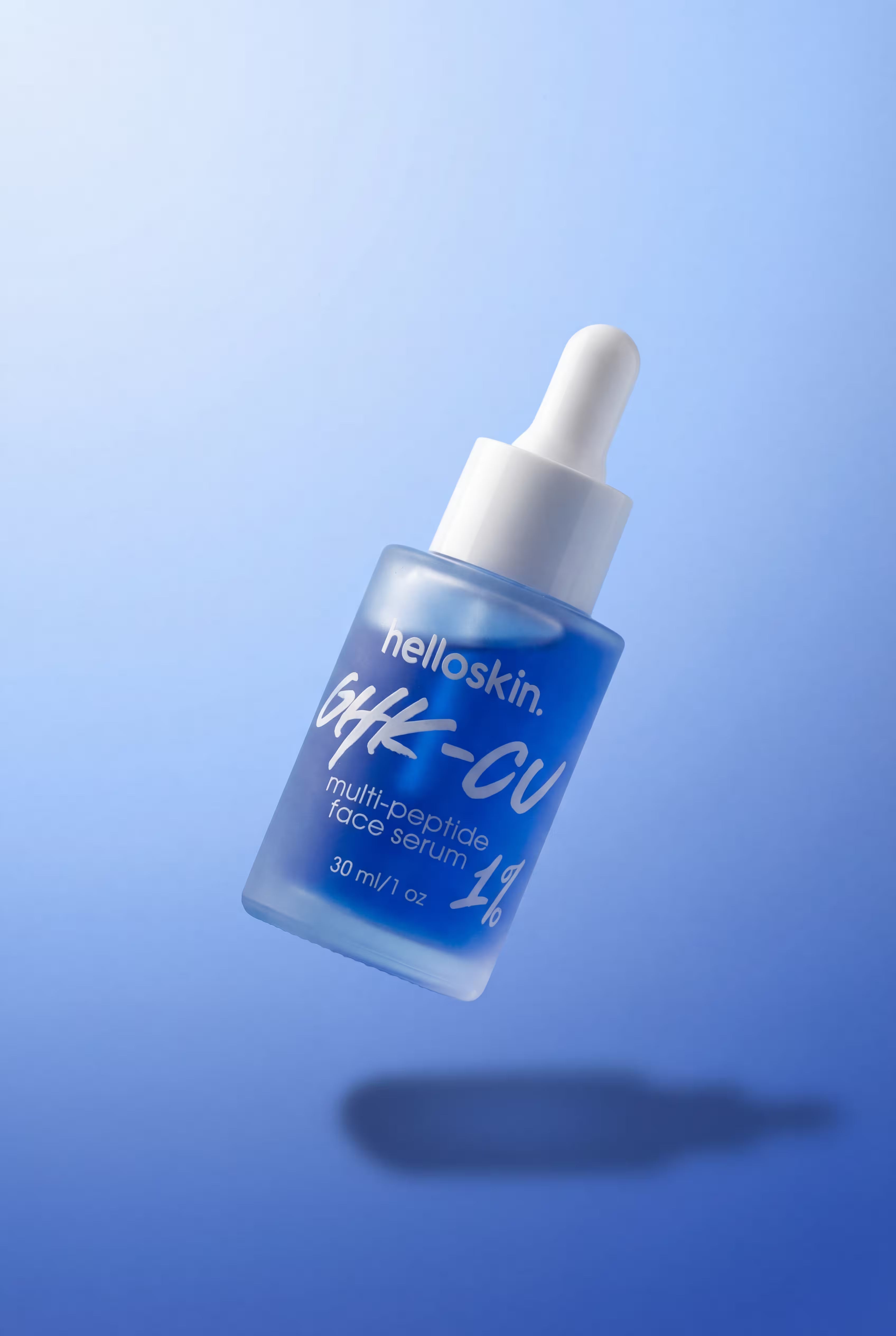
Helloskin vs PeptiClinic
PeptiClinic's Copper Peptide + KPV Repair Serum pairs GHK-Cu with KPV — a genuine anti-inflammatory tripeptide we don't carry, and a real point of difference. Credit for that. But the page publishes no full ingredient list and no percentages for either peptide, so there's no way to know how much of anything you're getting. We declare a full 9% peptide system, every dose, on a complete 16-ingredient label, scored 9.6/10 on a ChatGPT ingredient scan. Here's the breakdown — no spin, just chemistry.
A genuine repair peptide in KPV — but paired with GHK-Cu at doses the page never states, on a label it doesn't fully publish.
The two formulas, side by side.
Every spec that matters — including KPV, the repair peptide PeptiClinic genuinely has and we don't.
A repair peptide, or a declared system?
KPV (Lys-Pro-Val) is the real story here — a short peptide with genuine anti-inflammatory, barrier-calming interest that we don't offer. That's a fair reason to like this serum. The catch is that neither KPV nor the GHK-Cu comes with a percentage, and there's no full INCI to place them.
peptide doses disclosed
GHK-Cu and KPV are both named, and KPV is a genuinely interesting repair peptide. But no percentage is given for either, and the page doesn't publish a full ingredient list — so you can't tell how much of either you're applying.
every peptide declared
1.2% GHK-Cu + 5% Palmitoyl Tripeptide-1 + 3% Palmitoyl Tetrapeptide-7 — Matrixyl 3000 — all declared, antioxidant-protected, on a full 16-ingredient label.
Credit where it's due: KPV is a real anti-inflammatory peptide we don't carry, and if calming is your priority it's a genuine draw. But for a serum sold on copper peptide, undisclosed doses and a partial label tell you less than a fully-declared system.
What's on the record.
You can only judge the doses a brand publishes. Here's what each label actually declares.
PeptiClinic genuinely offers a peptide we don't — KPV — and that's worth real credit. But two named peptides at undisclosed doses, on a page without a full INCI, is a smaller, less verifiable formula than a declared 9% system on a complete label.
We ran our formula through a ChatGPT ingredient scan.
The prompt: "Scan this like a shopper comparing GHK-Cu serums, using the INCI list and confirmed peptide percentages." Because every dose is declared, there's something real to score.
"A genuinely serious copper peptide serum"
In its words: "not one where the peptides are buried at tiny marketing levels — with 1.2% verified GHK-Cu and 9% total peptides, this sits in a genuinely premium performance category."
Peptide strength
Ingredient quality 9.8 · Formula concept 9.6 · Hydration 9.4 · Barrier support 9.3 · No fairy-dusting 10/10.
Based on a saved ChatGPT-style formula review of the declared ingredient list and confirmed percentages. Not medical advice, not a live AI result, and not a third-party endorsement. Watch the full scan on the product page →
All 15 categories. Scored fairly.
Helloskin wins 11, ties 2, cedes 2. PeptiClinic genuinely wins on its KPV repair peptide and its headline price. Credit where it's due.
Every ingredient. Both labels, side by side.
We publish all 16 ingredients and every peptide dose. PeptiClinic names its two peptides but doesn't publish a full INCI or any percentages.
What PeptiClinic gets right.
There's a real idea here. KPV — Lys-Pro-Val — is a genuinely interesting peptide with anti-inflammatory and barrier-calming research behind it, and it's one we don't carry. Pairing it with GHK-Cu is a thoughtful combination for reactive or compromised skin, the serum is a stated 30ml dispatched from an Australian facility, and at $64.90 it undercuts us on price. If a calming, repair-focused peptide is your priority, that's a legitimate reason to choose it.
Where we pull ahead is disclosure and completeness. Neither GHK-Cu nor KPV comes with a percentage, and the page doesn't publish a full ingredient list, so you can't tell how much of either peptide you're getting or what else is in the bottle. There's no Matrixyl for collagen support, and no stated antioxidant to protect a copper peptide that oxidises. We publish a 9% peptide system to the decimal on a full 16-ingredient label, add Niacinamide and Tocopherol, and tell you it's 30ml. A repair peptide is a real plus; a dose you can trust is the foundation.
What people actually ask.
What is KPV, and does Helloskin have it?
How much GHK-Cu and KPV are in the PeptiClinic serum?
PeptiClinic is cheaper — is it better value?
Which one should I choose?
How we stack up against the rest.
Every comparison is the same honest, ingredient-level breakdown. No marketing, just chemistry.
Helloskin vs Allies of Skin
A $327 ectoin-and-antioxidant serum with the copper peptides declared as "complexes" near the bottom of the label.
Helloskin vs NIOD CAIS3
1% GHK-Cu + 1% GHK at premium pricing. Brilliant peptide chemistry — but no antioxidant, no Niacinamide.
Helloskin vs Double Bay Cosmetics
A 100ml serum with a bold 5% GHK-Cu, a BHA and 30 ingredients — big numbers, but no niacinamide, and copper efficacy is about delivery, not a bigger dose.
Helloskin vs NXTGEN Labs
Same $89.99, same 30ml, also Australian, with Niacinamide — but a single copper peptide at an undisclosed dose, no Matrixyl, no antioxidant.
Helloskin vs Suma Nurica
A mix-it-yourself powder + solution at $139 — the copper peptide is undisclosed, and the mixed serum runs clear.
Helloskin vs Cu Hair Skin
A little more copper (1.5%) and a lower price — but no Matrixyl, no antioxidant, no Niacinamide, and its 'expression' peptides are trace at the label's end.
Helloskin vs Ethan Thomas
A tidy 2% GHK-Cu single-peptide serum — but a stock, off-the-shelf formula (its INCI is resold under other brands), one peptide, no Niacinamide.
Helloskin vs The Ordinary
Eight peptides at trace concentrations under one "1%" claim. Sophisticated formula, opaque label.
Helloskin vs RegenMed Direct
A peptide-and-EGF serum with a long ingredient list — but just 0.5% GHK-Cu, undisclosed doses, no antioxidant, and no stated size.
Helloskin vs Wonderlini
A competent serum, but an off-the-shelf one — 1.5% copper on a stock white-label base (the same INCI is resold under other brands), no Matrixyl, no Niacinamide.
Helloskin vs Division Twenty
2% GHK-Cu in water with a preservative pair — no delivery system, no antioxidant, no supporting actives.
Helloskin vs Premium Peps
A 'triple peptide' serum that publishes no INCI, no percentages and no size — and carries a 'research use only' disclaimer.
A dose you can actually see.
1.2% GHK-Cu in a declared 9% peptide system with Matrixyl 3000. Every percentage on a full 16-ingredient label. Antioxidant-protected. 30ml. $89.99.
Shop GHK-Cu Serum — $89.99→