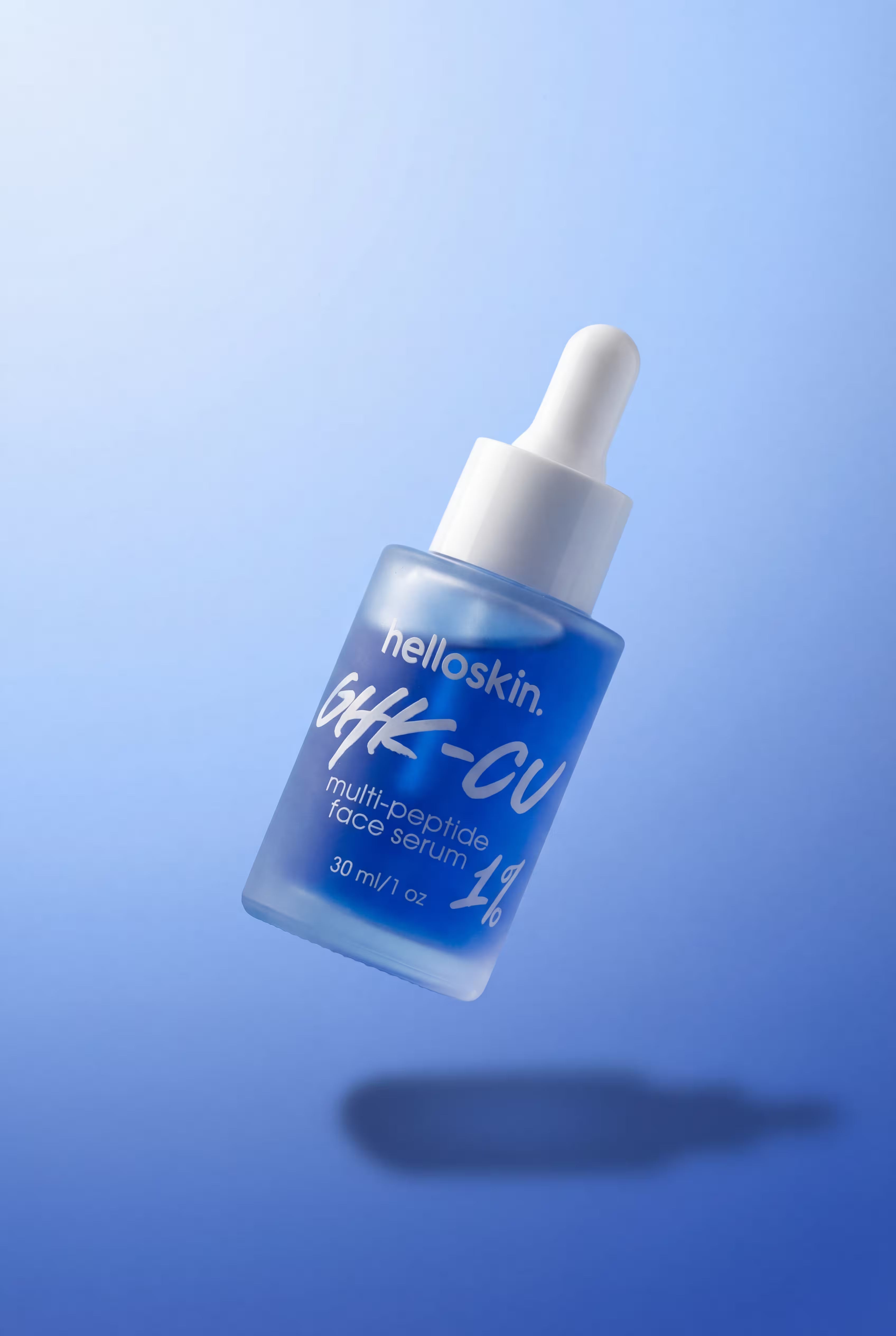
Helloskin vs Division Twenty
They lead with 2% GHK-Cu. We lead with 9% total active peptides and a delivery system that actually gets them through your skin. The full ingredient-level breakdown — no marketing, just chemistry.
Concentration without delivery is just expensive blue water.
The numbers, side by side.
Every spec that matters in a peptide serum. Hover any row on desktop, tap to expand on mobile.
Why 1.2% enhanced beats 2% unenhanced.
Division Twenty's marketing rests on one claim: 2% GHK-Cu is double the concentration of most serums. Factually true. Scientifically misleading.
Maximum without enhancement
Without a penetration system, only 0.6–2.8% of applied GHK-Cu reaches the dermis. The rest sits on the skin surface and wipes off on your pillowcase. Division Twenty's 2% formula contains zero penetration enhancers.
More peptide through
Helloskin's Propanediol + 1,2-Hexanediol dual carrier disrupts stratum corneum lipid packing and pushes hydrophilic peptides deeper. Published enhancement factors of 2–4× for peptide-class molecules.
↓ Helloskin · with delivery system
Peptides pass through all skin layers, reaching the dermis where fibroblasts produce collagen.
↓ Division Twenty · no delivery
Peptides stall in the upper stratum corneum. Most wipes off before reaching target cells.
What actually reaches your skin cells.
Applied dose × penetration factor × dermal absorption = what works. The breakdown.
Even at conservative estimates, the dermal delivery ranges overlap. But Helloskin also delivers an additional 7.8% of Matrixyl 3000 peptides working on two repair pathways Division Twenty simply doesn't have.
The 2% you buy isn't the 2% you apply.
GHK-Cu is redox-active. Without antioxidant protection, the copper peptide degrades fast.
degradation within 72 hours of ambient air exposure
GHK-Cu is redox-active — the copper ion readily accepts or donates electrons. In oxygen, moisture, and light, it degrades fast.
Helloskin includes Tocopherol (Vitamin E) as a dedicated antioxidant. Division Twenty has zero protection.
We ran our formula through a ChatGPT ingredient scan.
The prompt: "Scan this like a shopper comparing GHK-Cu serums, using the INCI list and confirmed peptide percentages." Because every dose is declared, there's something real to score.
"A genuinely serious copper peptide serum"
In its words: "not one where the peptides are buried at tiny marketing levels — with 1.2% verified GHK-Cu and 9% total peptides, this sits in a genuinely premium performance category."
Peptide strength
Ingredient quality 9.8 · Formula concept 9.6 · Hydration 9.4 · Barrier support 9.3 · No fairy-dusting 10/10.
Based on a saved ChatGPT-style formula review of the declared ingredient list and confirmed percentages. Not medical advice, not a live AI result, and not a third-party endorsement. Watch the full scan on the product page →
All 15 categories. One winner.
Helloskin wins 14 of 15. Division Twenty's only win: raw GHK-Cu concentration.
Complete ingredient lists. No hidden percentages.
Every ingredient declared. Both formulas, side by side.
What Division Twenty gets right.
Credit where it's due. Their DTC marketing is sharp — clean headline, good price point ($49.99 USD), 90-day guarantee that removes purchase friction. The minimalist "no BS, just the active" positioning resonates with ingredient-conscious consumers tired of 40-ingredient formulas where nothing's at a working concentration.
The problem is that their formula expertise doesn't match their marketing expertise. A compounding pharmacist could make this product in 10 minutes. It's copper peptide dissolved in water with a preservative pair and a pH adjuster. That's not a finished skincare serum — it's a raw active in a basic vehicle.
What people actually ask.
Isn't 2% GHK-Cu better than 1.2%?
What does "9% total active peptides" mean?
Why does Division Twenty's formula only have 5 ingredients?
Is Division Twenty a bad product?
Where is Helloskin made?
How long until I see results?
How we stack up against the rest.
Every comparison is the same honest, ingredient-level breakdown. No marketing, just chemistry.
Helloskin vs Allies of Skin
A $327 ectoin-and-antioxidant serum with the copper peptides declared as "complexes" near the bottom of the label.
Helloskin vs NIOD CAIS3
1% GHK-Cu + 1% GHK at premium pricing. Brilliant peptide chemistry — but no antioxidant, no Niacinamide.
Helloskin vs Double Bay Cosmetics
A 100ml serum with a bold 5% GHK-Cu, a BHA and 30 ingredients — big numbers, but no niacinamide, and copper efficacy is about delivery, not a bigger dose.
Helloskin vs NXTGEN Labs
Same $89.99, same 30ml, also Australian, with Niacinamide — but a single copper peptide at an undisclosed dose, no Matrixyl, no antioxidant.
Helloskin vs Suma Nurica
A mix-it-yourself powder + solution at $139 — the copper peptide is undisclosed, and the mixed serum runs clear.
Helloskin vs Cu Hair Skin
A little more copper (1.5%) and a lower price — but no Matrixyl, no antioxidant, no Niacinamide, and its 'expression' peptides are trace at the label's end.
Helloskin vs PeptiClinic
GHK-Cu paired with KPV, a genuine repair peptide — but no full INCI, and no percentage stated for either peptide.
Helloskin vs Ethan Thomas
A tidy 2% GHK-Cu single-peptide serum — but a stock, off-the-shelf formula (its INCI is resold under other brands), one peptide, no Niacinamide.
Helloskin vs The Ordinary
Eight peptides at trace concentrations under one "1%" claim. Sophisticated formula, opaque label.
Helloskin vs RegenMed Direct
A peptide-and-EGF serum with a long ingredient list — but just 0.5% GHK-Cu, undisclosed doses, no antioxidant, and no stated size.
Helloskin vs Wonderlini
A competent serum, but an off-the-shelf one — 1.5% copper on a stock white-label base (the same INCI is resold under other brands), no Matrixyl, no Niacinamide.
Helloskin vs Premium Peps
A 'triple peptide' serum that publishes no INCI, no percentages and no size — and carries a 'research use only' disclaimer.
Peptides that actually get through.
9% total active peptides. Dual-carrier delivery. Australian-made. 30-day returns.
Shop GHK-Cu Serum — $89→