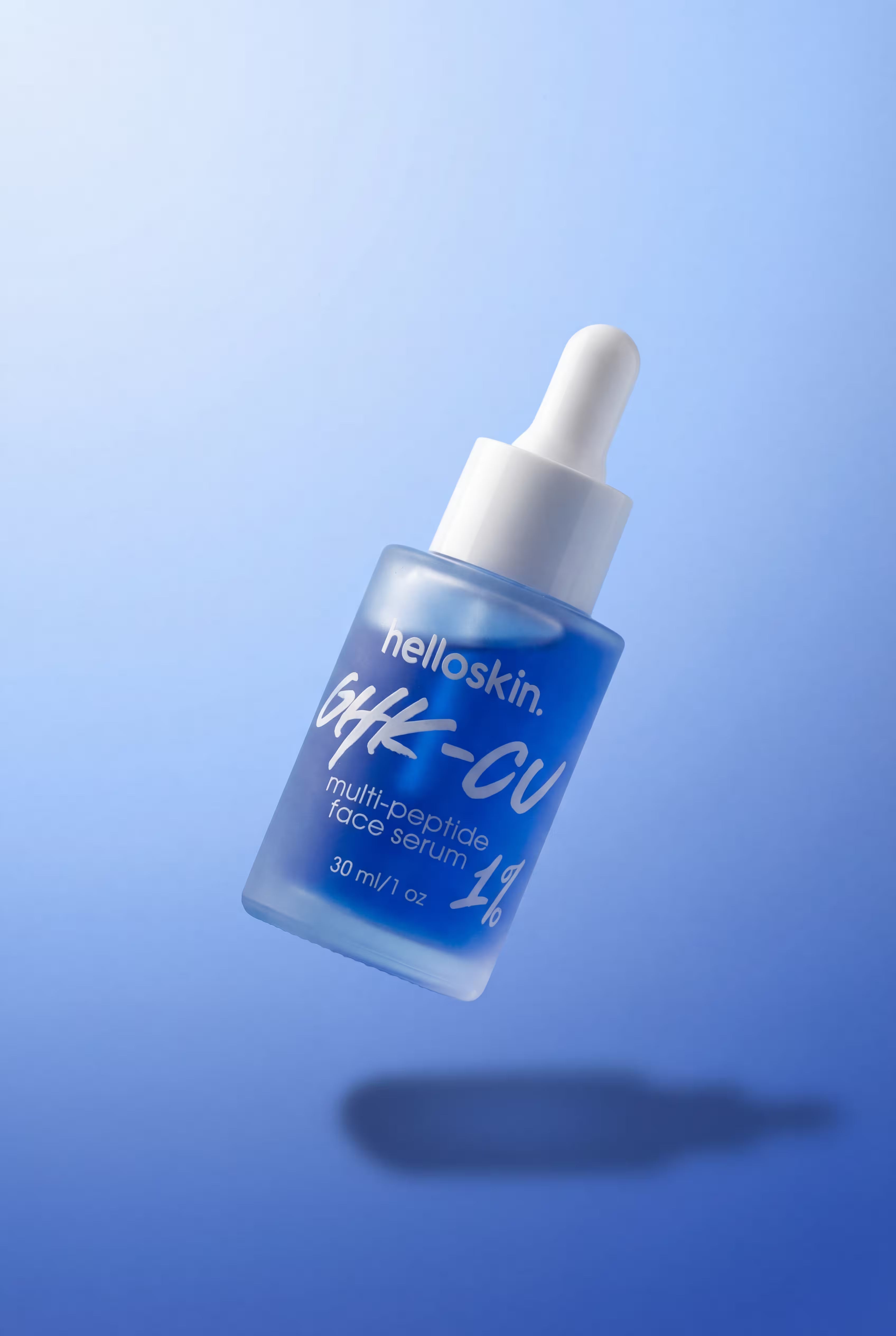
Helloskin vs The Ordinary
They list eight peptides at undisclosed concentrations under one "1%" claim. We declare every gram of every peptide — 9% total active peptides across three pathways. The full ingredient-level breakdown — no marketing, just chemistry.
Eight peptides. How much of each?
The numbers, side by side.
Every spec that matters in a peptide serum. Hover any row on desktop, tap to expand on mobile.
Why 9% declared beats 1% lumped.
The Ordinary's "Multi-Peptide + Copper Peptides 1%" label combines eight peptides under a single "1%" total. The math means each individual peptide is at a trace concentration — and we don't know which is which.
per peptide, if split evenly
The Ordinary lists 8 peptides totalling 1%. INCI position suggests GHK-Cu (Copper Tripeptide-1) is the largest of the eight, but even at the most generous estimate, individual peptide concentrations sit in the 0.1–0.4% range. Below the threshold where most peptides demonstrate clinical effect.
declared, peptide by peptide
Helloskin lists three peptides at clinical concentrations: 1.2% GHK-Cu, 5% Palmitoyl Tripeptide-1, 3% Palmitoyl Tetrapeptide-7. Every concentration on the label, every peptide included at a declared cosmetic level.
↓ Helloskin · 3 peptides at clinical %
Three peptides delivered at 9% combined — full working concentrations reaching the dermis.
↓ The Ordinary · 8 at trace %
DMI delivery works — but eight peptides at ~0.125% each means trace amounts reach the dermis.
The peptide load, peptide by peptide.
Both formulas have penetration enhancers. The difference is what's in the bottle to deliver.
The Ordinary's formula contains 9× less total declared peptide. Their multi-peptide approach is real — but at lumped trace concentrations, each individual peptide sits below the dose levels shown to produce clinical effects in published studies.
The 1% you buy isn't the 1% you apply.
GHK-Cu is redox-active. Without antioxidant protection, the copper peptide degrades fast — and The Ordinary's formula has none.
degradation within 72 hours of ambient air exposure
GHK-Cu is redox-active — the copper ion readily accepts or donates electrons. In oxygen, moisture, and light, it degrades fast.
Helloskin includes Tocopherol (Vitamin E) as a dedicated antioxidant. The Ordinary's INCI list contains no antioxidants for peptide stabilisation.
We ran our formula through a ChatGPT ingredient scan.
The prompt: "Scan this like a shopper comparing GHK-Cu serums, using the INCI list and confirmed peptide percentages." Because every dose is declared, there's something real to score.
"A genuinely serious copper peptide serum"
In its words: "not one where the peptides are buried at tiny marketing levels — with 1.2% verified GHK-Cu and 9% total peptides, this sits in a genuinely premium performance category."
Peptide strength
Ingredient quality 9.8 · Formula concept 9.6 · Hydration 9.4 · Barrier support 9.3 · No fairy-dusting 10/10.
Based on a saved ChatGPT-style formula review of the declared ingredient list and confirmed percentages. Not medical advice, not a live AI result, and not a third-party endorsement. Watch the full scan on the product page →
All 15 categories. Where each wins.
Helloskin wins 14 of 15 on the formula. The Ordinary wins 1: value per dollar.
Complete ingredient lists. Side by side.
Sixteen functional ingredients vs forty-nine including humectants, amino acids, sugars, and preservatives.
What The Ordinary gets right.
The Ordinary deserves real credit. They democratised peptide skincare. Before DECIEM made $32 multi-peptide serums standard, copper peptide formulations sat behind $150+ luxury price tags or in injectable clinics. They opened the category to millions of people who would never have tried peptides otherwise.
The formula itself is more sophisticated than most ingredient-conscious shoppers realise. It includes a real penetration enhancer (Dimethyl Isosorbide), genuine multi-weight hyaluronic acid, an amino acid + sugar humectant complex, and Allantoin for soothing. The peptide variety — eight different peptides — is genuinely broad.
The critique isn't of their formula philosophy. It's of the label. "1% Copper Peptides" tells you the combined concentration of all copper peptides, but with eight peptides in the formula, individual concentrations land in the trace range. You don't know whether the GHK-Cu is at 0.5% or 0.05%. And without antioxidant protection, whatever concentration is on the label degrades fast once the bottle is opened.
For someone trying peptides for the first time at a budget price point, The Ordinary is a reasonable entry. For someone who wants to know exactly what they're applying — and to know it's stable, supported, and at clinical concentrations — that's a different product.
What people actually ask.
Isn't The Ordinary's "1% copper peptides" the same as your 1.2% GHK-Cu?
Doesn't The Ordinary have more peptides than Helloskin?
The Ordinary has DMI for penetration — isn't that the same as your delivery system?
Is The Ordinary a bad product?
Why does The Ordinary use Phenoxyethanol and Chlorphenesin?
Is the price difference worth it?
How we stack up against the rest.
Every comparison is the same honest, ingredient-level breakdown. No marketing, just chemistry.
Helloskin vs Allies of Skin
A $327 ectoin-and-antioxidant serum with the copper peptides declared as "complexes" near the bottom of the label.
Helloskin vs NIOD CAIS3
1% GHK-Cu + 1% GHK at premium pricing. Brilliant peptide chemistry — but no antioxidant, no Niacinamide.
Helloskin vs Double Bay Cosmetics
A 100ml serum with a bold 5% GHK-Cu, a BHA and 30 ingredients — big numbers, but no niacinamide, and copper efficacy is about delivery, not a bigger dose.
Helloskin vs NXTGEN Labs
Same $89.99, same 30ml, also Australian, with Niacinamide — but a single copper peptide at an undisclosed dose, no Matrixyl, no antioxidant.
Helloskin vs Suma Nurica
A mix-it-yourself powder + solution at $139 — the copper peptide is undisclosed, and the mixed serum runs clear.
Helloskin vs Cu Hair Skin
A little more copper (1.5%) and a lower price — but no Matrixyl, no antioxidant, no Niacinamide, and its 'expression' peptides are trace at the label's end.
Helloskin vs PeptiClinic
GHK-Cu paired with KPV, a genuine repair peptide — but no full INCI, and no percentage stated for either peptide.
Helloskin vs Ethan Thomas
A tidy 2% GHK-Cu single-peptide serum — but a stock, off-the-shelf formula (its INCI is resold under other brands), one peptide, no Niacinamide.
Helloskin vs RegenMed Direct
A peptide-and-EGF serum with a long ingredient list — but just 0.5% GHK-Cu, undisclosed doses, no antioxidant, and no stated size.
Helloskin vs Wonderlini
A competent serum, but an off-the-shelf one — 1.5% copper on a stock white-label base (the same INCI is resold under other brands), no Matrixyl, no Niacinamide.
Helloskin vs Division Twenty
2% GHK-Cu in water with a preservative pair — no delivery system, no antioxidant, no supporting actives.
Helloskin vs Premium Peps
A 'triple peptide' serum that publishes no INCI, no percentages and no size — and carries a 'research use only' disclaimer.
Every peptide, at a clinical dose.
9% declared peptide load. Three repair pathways. Antioxidant-protected. Australian-made.
Shop GHK-Cu Serum — $89→