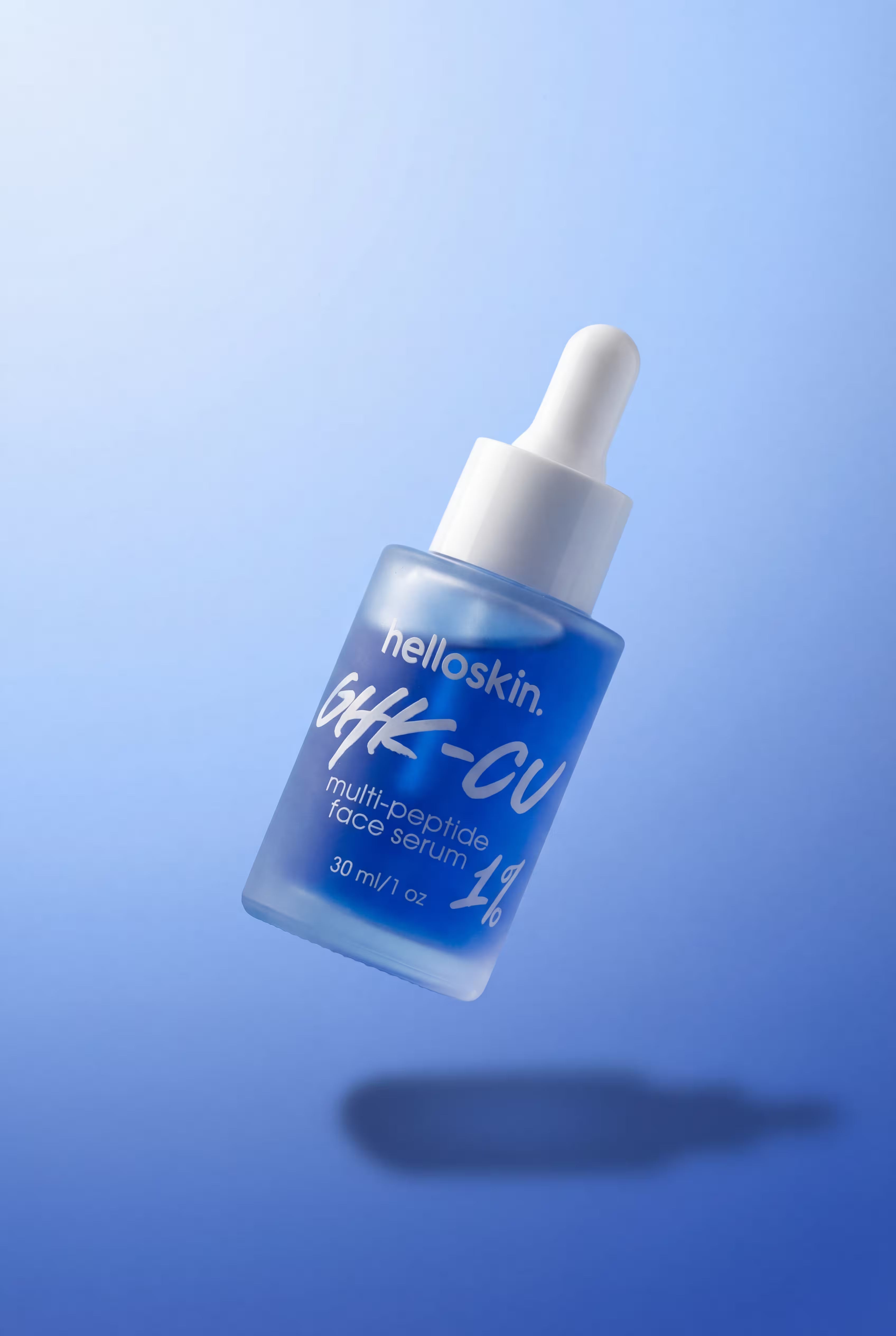
GHK-Cu, also called Copper Tripeptide-1, is a copper-bound peptide used in cosmetic formulas for firmer-looking, calmer-looking, more resilient skin. Helloskin built it into a daily topical serum with a transparent concentration story and a supporting peptide stack.
A copper-bound tripeptide: three amino acids, glycine, histidine, and lysine, attached to a copper ion. In skincare, GHK-Cu is used as a signal peptide for routines focused on visible firmness, texture, and calmer-looking skin.
Supports firmer-looking skin routines
GHK-Cu signals your fibroblasts, which are associated with firmness and skin structure. They slow down as we age. GHK-Cu supports a more active-looking skin routine.
Supports calmer-looking skin
Lowers visible signs of skin stress. Tends to feel calming rather than aggravating, even on sensitive skin.
Antioxidant defence
Quenches free radicals directly and supports your skin's own antioxidant enzymes. In some assays, outperforms vitamin C against UV-driven damage.
Supports repair after disruption
Discussed in recovery-focused research contexts. In skincare, useful after microneedling, laser, or any disruption to the barrier.
What it does
What GHK-Cu does in skin.
GHK-Cu signals the cells in your skin that support firmness — fibroblast-related pathways associated with firmer-looking skin.
Peptide signalA cosmetic signal peptide with a long research story.
This visual slot keeps the education premium while the chapter carries the deeper educational content.
It's amazing the way it works. The cells in your skin that actually support firmness — fibroblasts — slow down as we age. They stop working as hard. GHK-Cu supports a more active-looking skin routine. That's the simplest way to put it. And once those cells start supporting firmer-looking skin, you start seeing what comes with that — firmer-looking skin, fewer fine lines, better texture.
The published research on GHK-Cu is unusually deep. Maquart and colleagues showed in 1988 that GHK-Cu in fibroblast cultures supported collagen production at up to 70% above baseline. The 2018 Pickart review found GHK-Cu modulates over 4,000 human genes — and around a third of those are skin-recovery related pathways. That's why it's so multifunctional. It's not just signalling collagen, it's signalling everything skin needs to look more resilient.
GHK-Cu doesn't force anything. It's a signal. Send it consistently and the cells respond.
Evidence notes
Research context, kept separate from product claims.
GHK-Cu has a long ingredient-level research history. This section keeps study context separate from finished-product claims so the page stays useful and careful.
Evidence note
Published research context
GHK-Cu has one of the longest research arcs in cosmetic peptide science — over 50 years and 90+ peer-reviewed papers.
The foundational reference points: Pickart's original 1973 isolation of GHK from human plasma at academic research. Maquart 1988, the first in-vitro proof of firmness-supporting activity in fibroblast cultures. Mulder 1994, showing improved visible resilience of pressure ulcers in human patients with topical GHK-Cu. Leyden 2008, the 12-week clinical trial showing reduced fine lines and improved firmness vs vehicle control. Pickart and Margolina 2012, the antioxidant capacity work. And Pickart, Vasquez-Soltero, Margolina 2018 — the comprehensive gene-expression review that mapped 4,192 human genes modulated by GHK-Cu (31.2% repair, 22.4% visible skin stress, 16.6% antioxidant).
The 2018 Pickart paper is open-access. If you want one read, it's that one.
Ingredient-level context. Final citations require Souraya review.
Evidence note
Formulation note
GHK-Cu has been around since the 1970s. We designed Helloskin GHK-Cu as a focused topical serum with a transparent concentration story. The right concentration is the main focus — and that's not necessarily the highest concentration on offer. We chose 1.2% because that's where the published research shows GHK-Cu starts working properly. We label it 1%. We round down. Consistency is always key, especially when it comes to peptides — keep it simple, cleanse, GHK-Cu serum, moisturise, every single day, and you'll start to see results in two to three weeks.
Founder/formulation context. Final claims require review.
How to use it
How to layer GHK-Cu without routine chaos.
Cleanse, GHK-Cu serum, moisturise. Once a day. Consistency is always key.
Keep the routine simple.
Cleanse, GHK-Cu serum, moisturise. Once a day. Consistency is always key.
What to combine. What to keep apart.
GHK-Cu doesn't play with acids like vitamin C. AM vitamin C, PM GHK-Cu — or four hours apart.
What to expect, week by week.
Stay consistent for at least 4–8 weeks before judging results. Real change takes 12 weeks or more.
How to use it
Keep the routine simple.
Cleanse, GHK-Cu serum, moisturise. Once a day. Consistency is always key.
Routine mapCleanse, GHK-Cu serum, moisturiser. Keep it simple.
This visual breaks up the long-form routine guidance and gives skimmers the fast answer first.
Cleanse. GHK-Cu serum. Moisturise. That's it.
Apply on clean, slightly damp skin. Press in. Give it 60 to 90 seconds before layering anything heavier. Once a day is enough — most people use it at night, but it's gentle enough for morning use under SPF.
Consistency is always key — especially with peptides. You're not forcing the skin to do something. You're sending a signal it can use. Send the signal once a week and nothing happens. Send it every day and the cells start responding. Most people see hydration and texture changes in two to three weeks, and visible firmness changes from around 8 to 12 weeks.
What to combine. What to keep apart.
GHK-Cu pairs well with Niacinamide, Hyaluronic Acid, Retinol, Panthenol, and Madecassoside. Most of those are already in our formula.
The one rule worth respecting: GHK-Cu doesn't play with strong acids like vitamin C — they can cancel each other out. If you use vitamin C in your morning routine, swap GHK-Cu to your evening routine. Or run them at least four hours apart. Stable vitamin C derivatives (SAP, MAP, THDA) are more compatible than pure ascorbic acid.
The old internet warnings about peptides and niacinamide cancelling each other out are outdated. Modern formulations stabilise peptides adequately for normal layering.
GHK-Cu doesn't play with acids like vitamin C. AM vitamin C, PM GHK-Cu — or four hours apart.
What to expect, week by week.
visible firmness supports on a biological timeline, not a marketing timeline. Anyone promising fine-line erasure in 14 days isn't being honest about how skin works.
Weeks 1–2: Skin feels softer and more hydrated. Surface texture starting to smooth out.
Weeks 3–4: Visible plumpness. Fine lines slightly less prominent in side lighting.
Weeks 5–8: Skin looks more rested. Acne marks fading. Stronger barrier.
Weeks 8–12: Measurable fine line reduction. Firmness improving. Tone evening out.
Weeks 12+: Real visible firmness support becoming visible. The longer GHK-Cu is in your routine, the more it does.
The earliest published clinical trial showing measurable wrinkle reduction (Leyden, 2008) used 12 weeks of consistent topical use as the benchmark. That's what the science supports — and what we've seen in customers ourselves.
Stay consistent for at least 4–8 weeks before judging results. Real change takes 12 weeks or more.
Most people see hydration and texture changes in two to three weeks. Real firmness changes need 8–12 weeks. That's biology, not marketing.
Shop the serum
The Helloskin GHK-Cu serum.
The education should lead naturally into the product, without turning every section into a sales block.
1.2% pure Copper Tripeptide-1 (label states 1%) 30mL Triple-peptide blend with Matrixyl 3000 and Rigin. 16 ingredients total. Australian made. No fragrance, no silicones, no parabens, no sulfates.
GHK-Cu paired with Matrixyl 3000 and Rigin — three peptides working together for amplified signalling.
Matrixyl 3000 (Palmitoyl Tripeptide-1)
Already paired in our formula
Rigin (Palmitoyl Tetrapeptide-7)
Already paired in our formula
PDRN
Different mechanism, same goal — pairs perfectly as the Repair Duo
Niacinamide
Already in our formula — pairs cleanly
Retinol
Use in a broader routine if your skin tolerates it
Madecassoside
Already in our formula — soothing active
Inside the bottle
The triple-peptide stack.
GHK-Cu paired with Matrixyl 3000 and Rigin — three peptides working together for amplified signalling.
Formula mapThree peptides, supporting ingredients, and a short INCI list.
This chapter is where the page explains the formula rather than just naming the hero ingredient.
Helloskin's GHK-Cu Triple-Peptide Serum is built on three peptides working together.
Copper Tripeptide-1 (GHK-Cu) at 1.2% — the primary signal peptide. Drives firmness and texture support.
Palmitoyl Tripeptide-1 (Matrixyl 3000) — a complementary collagen-signalling peptide with a fatty-acid tail for easier skin penetration. Works through related pathways and amplifies the GHK-Cu signal.
Palmitoyl Tetrapeptide-7 (Rigin) — calming-support peptide. Calms the response while the other two rebuild.
Around that core, the formula carries Niacinamide for sebum and barrier support, Panthenol for soothing, Madecassoside (the active fraction of Centella) for visible resilience, and three molecular weights of Hyaluronic Acid for hydration at multiple skin depths. 16 ingredients total. No fragrance. No silicones. No parabens. No sulfates.
Why we run 1.2% and label it 1%.
The right concentration is the main focus — and that's not necessarily the highest concentration on offer in a serum. Most other brands run between 0.5% and 1%. Some put a tiny amount of the active in their formula, slap it on the packaging and charge a premium for it. We chose 1.2% because that's where the published research shows GHK-Cu actually works — between roughly 0.5% and 2% is where the response curve is clearest, and it plateaus around the upper end of that range.
The label says 1%. The real concentration is 1.2%. The 0.2% gap is intentional. We round down on numbers. The skincare industry has been rounding up for decades — overstating what's actually in the bottle, claiming higher percentages of 'complex' formulations where the actual active is a fraction of the label. We'd rather under-promise and let the formula over-deliver.
That's not marketing. That's how the formula was designed.
Label says 1%. Bottle delivers 1.2%. The skincare industry rounds up. We round down.
Free from.
No fragrance. No silicones. No parabens. No sulfates. Australian made. The full INCI is 16 ingredients. Every one of them does work — no fillers, no fluffy formulas to make the bottle look impressive on the back label.
16 ingredients. All working.
Three peptides, one serum. The signal is amplified, not just additive.
INCI snapshot
Complete ingredient context.
Two of the three peptides (Palmitoyl Tripeptide-1 in position 3 and Palmitoyl Tetrapeptide-7 in position 6) sit in the top half of the INCI — high concentration positioning. Niacinamide appears in position 4. Copper Tripeptide-1 sits in position 8 because copper-bound peptides are highly active per gram and work effectively at sub-1% concentrations. Total active load through the first 8 ingredients.
Two of the three peptides (Palmitoyl Tripeptide-1 in position 3 and Palmitoyl Tetrapeptide-7 in position 6) sit in the top half of the INCI — high concentration positioning. Niacinamide appears in position 4. Copper Tripeptide-1 sits in position 8 because copper-bound peptides are highly active per gram and work effectively at sub-1% concentrations. Total active load through the first 8 ingredients.
Formula notes
16 ingredients. Made in Australia. Free from: Fragrance, Silicones, Parabens, Sulfates.
FAQ
GHK-Cu questions, answered.
The questions we get asked most about GHK-Cu, answered straight.
What is GHK-Cu?
GHK-Cu is Copper Tripeptide-1 — three amino acids (glycine, histidine, lysine) bound to a copper ion. It's a naturally-occurring signalling peptide that is used in cosmetic routines focused on firmness, texture, and visible resilience. It was discovered in 1973 by Loren Pickart at academic research.
Can I use GHK-Cu while pregnant or breastfeeding?
Ask your healthcare professional before using GHK-Cu during pregnancy or breastfeeding. This page is general skincare education only and should not replace professional advice.
Why is the bottle labelled 1% if the formula is 1.2%?
We round down on numbers. The published response curve for GHK-Cu plateaus around 1.2%, so we formulate at the meaningful concentration but label conservatively. The skincare industry rounds up; we round down. The 0.2% gap is intentional and disclosed openly here.
What's the right concentration of GHK-Cu?
Published research shows the response is clearest in the 0.5% to 2% range. Below 0.5% the active is underpowered. Above 2% the response plateaus and irritation risk increases. Helloskin runs at 1.2% — the upper end of the most-studied range.
Can I use GHK-Cu with Retinol?
Yes. Apply GHK-Cu first on slightly damp skin, allow 60 to 90 seconds for absorption, then apply Retinol. Use the combination at night. They work well together — GHK-Cu signals visible firmness support while Retinol drives cell turnover.
Can I use GHK-Cu with Vitamin C?
Not in the same routine. GHK-Cu doesn't play with strong acids like vitamin C — they can cancel each other out. Use Vitamin C in your morning routine and GHK-Cu in your evening routine, or run them at least four hours apart. Stable vitamin C derivatives (SAP, MAP, THDA) are more compatible than pure ascorbic acid.
How long does GHK-Cu take to work?
Hydration and texture changes typically appear in 2 to 4 weeks. Fine line and tone changes in 8 to 12 weeks. Real firmness and post-mark appearance support takes 12 weeks or more — visible firmness supports on a 90 to 120 day biological cycle. Consistency is always key — especially with peptides.
Can men use GHK-Cu?
Yes. Skin biology around fibroblast signalling and firmness-supporting activity isn't sex-specific. The serum works the same on men's skin.
Can I use GHK-Cu in a scalp-focused routine?
Copper peptides can appear in scalp-focused cosmetic formulas. If you use pharmacy or prescription scalp products, check compatibility with a professional.
Why is my GHK-Cu serum blue?
It should be. The copper-tripeptide complex is naturally blue — that's the visible signature of the active. If your serum has gone clear, the active may have degraded.
Can I use GHK-Cu after microneedling?
Yes — one of its strongest applications. Wait until the skin is no longer broken (usually day 2 to 3), then apply GHK-Cu nightly. The combination of microneedling and peptide signalling is one of the most well-supported stacks in cosmetic literature.
Should I worry about copper in topical skincare?
Topical cosmetic formulas use very small amounts. If you have a copper-related health concern, speak with a professional before use.
Is GHK-Cu vegan and cruelty-free?
Yes to both. Pure GHK-Cu is synthesised — no animal source. Helloskin's GHK-Cu Triple-Peptide Serum is vegan and cruelty-free. (PDRN is salmon-derived, so PDRN is not vegan. GHK-Cu is.)
Should I check with a professional before using GHK-Cu?
If you have a copper-related health concern or are unsure whether GHK-Cu suits your routine, check with a healthcare professional before use.
Can teenagers use GHK-Cu?
Generally not necessary. Younger skin already produces high amounts of endogenous GHK-Cu. The supporting actives in our formula (niacinamide, centella) are useful for teen skin, but the GHK-Cu component starts mattering most from your late twenties onward as natural production declines.
Does GHK-Cu have a 'purge' period like Retinol?
No. GHK-Cu doesn't drive cell turnover the way Retinol does, so there's no equivalent purging phase. If skin breaks out within the first two weeks of starting GHK-Cu, it's likely an unrelated factor (other actives, fragrance from another product, formulation incompatibility).
Can I take GHK-Cu orally?
No. GHK-Cu is broken down by digestive enzymes if ingested. Topical application is the only effective delivery route for skin benefits.
How should I store GHK-Cu serum?
Cool, dark, dry. Bathroom storage isn't ideal because of humidity and temperature swings. Refrigeration extends shelf life but isn't required. Keep the cap closed when not in use.
Why does my GHK-Cu serum smell faintly metallic?
Normal at trace levels — copper-bound peptides do that. A strong off-smell suggests degradation; discard.
Can I use GHK-Cu around my eyes, neck, and chest?
Yes. Gentle enough for the under-eye area. The neck and décolletage age fast and respond well to peptide signalling — extend application down through these zones nightly. Helloskin's Revive and Illuminate Peptide Eye Serums also use the same peptide signalling approach for the eye-specific zone.
What's the difference between GHK-Cu and home-use GHK-Cu?
Same INCI name, different format. GHK-Cu has been researched across multiple contexts, but this page is focused on topical cosmetic use. Helloskin's GHK-Cu Triple-Peptide Serum uses Copper Tripeptide-1 in a topical cosmetic format with two complementary peptides. Daily topical use, built for skincare routines.
What's the difference between GHK-Cu and Matrixyl 3000?
GHK-Cu is a tripeptide bound to copper. Matrixyl 3000 (Palmitoyl Tripeptide-1) is a similar signal peptide with a fatty-acid tail for easier penetration but no copper. Both signal firmness-supporting activity through related pathways. They're complementary — Helloskin's GHK-Cu Triple-Peptide Serum contains both.
What's the difference between GHK-Cu and PDRN?
Different pathways, both useful. GHK-Cu signals visible firmness support via fibroblasts. PDRN supports skin resilience via adenosine A2A receptors. Ask a healthcare professional about pregnancy or breastfeeding routines. Helloskin offers both GHK-Cu and PDRN individually and as the Repair Duo bundle.
What's the difference between GHK-Cu and Retinol?
Different mechanisms, different timelines. GHK-Cu signals visible firmness support. Retinol forces cell turnover via retinoic acid receptors. Most people run both — apply GHK-Cu first on damp skin, give it 60–90 seconds, then layer Retinol over the top. Use the combination at night.
What's the difference between GHK-Cu and Argireline?
Different problems. Argireline (Acetyl Hexapeptide-8) is used in cosmetic formulas aimed at the look of expression lines. GHK-Cu is used in firmness and resilience routines. They can sit in the same broader peptide routine if your skin tolerates it.
What's the difference between GHK-Cu and growth factors (EGF, FGF)?
GHK-Cu is smaller, more stable, more reliably bioavailable. Growth factors are large protein molecules — typically too big to penetrate the stratum corneum without specialised delivery. GHK-Cu is small (around 400 daltons) and penetrates reliably. Growth factors also raise stability concerns — proteins denature easily.
What's the difference between GHK-Cu and Niacinamide?
Complementary. Niacinamide regulates sebum, supports the barrier, fades post-acne marks. GHK-Cu signals firmness-supporting activity. They work on different problems and stack cleanly — that's why both are in the same Helloskin serum.
What's the difference between GHK-Cu and Snail Mucin?
GHK-Cu is a defined molecule. Snail mucin is a mixture. Snail mucin is a broad mix of glycoproteins, allantoin, hyaluronic acid, and trace peptides — pleasant but variable. GHK-Cu is a single specific molecule with 50 years of research behind it.
What's the difference between GHK-Cu and prescription Tretinoin?
Different mechanisms. Tretinoin is retinoic acid — the prescription-strength active form. Significantly more powerful than over-the-counter Retinol, with proportionally more irritation. GHK-Cu and Tretinoin work on different pathways and can be layered (apply GHK-Cu first, allow absorption, then Tretinoin). Many dermatology protocols use both for advanced firmness or texture routines.
What's the difference between pure GHK-Cu and a 'copper peptide complex'?
Read the label. They're not the same. Pure GHK-Cu is the specific molecule (Copper Tripeptide-1) with documented activity. 'Copper peptide complex' is a marketing term — it can mean GHK-Cu plus stabilisers, or a blend of various copper-bound peptides at undisclosed individual concentrations. A '1% copper peptide complex' might contain 0.1% pure GHK-Cu, or less. The label number doesn't tell you. Helloskin lists Copper Tripeptide-1 by INCI name with the actual concentration disclosed.
Can I use GHK-Cu if my skin flushes easily?
If your skin flushes easily, patch test first and introduce GHK-Cu slowly. Keep the rest of the routine simple and pause if your skin feels irritated.
Can I use GHK-Cu if my skin is reactive?
If your skin is reactive or currently flaring, keep your routine simple and follow professional guidance. Introduce new actives only when your skin feels settled.
Can I use GHK-Cu while using prescription skincare?
Check with your prescribing clinician before adding new actives alongside prescription skincare, especially if your skin is dry, peeling, or sensitised.
Can I use GHK-Cu with prescription retinoids?
Some routines include both peptides and retinoids, but prescription retinoids can make skin more sensitive. Ask your clinician and introduce slowly.
Is copper tripeptide-1 the same as GHK-Cu?
Yes. Copper Tripeptide-1 is the INCI name for GHK-Cu, the copper-bound form of the peptide GHK. Same ingredient – brands use "GHK-Cu" on the front and "Copper Tripeptide-1" on the back.
What is topical GHK-Cu?
Topical GHK-Cu is the copper peptide in a leave-on serum you apply to your skin, not inject. Same active the peptide community injects at home, formulated to work at the surface – no needles and no script. We formulate at 1.2% because that's where the response is consistent in published research.
What should you not mix with copper peptides?
Strong vitamin C and direct acids in the same layer at the same time – separate those by time of day. Retinol, niacinamide, hyaluronic acid and moisturiser are all fine. The "don't mix copper peptides" reputation is really just that one narrow pH clash, not a ban on everything.
Can you use GHK-Cu with vitamin C?
Yes, just not in the same layer. Strong vitamin C (L-ascorbic acid) works at a low, acidic pH and copper peptides prefer closer to neutral, so layered together each can blunt the other. Easy fix: vitamin C in the morning, ghkcu at night.
Can you use GHK-Cu with retinol?
Yes. There's no chemistry clash here – you just don't have to cram them into one layer. Most people alternate nights (retinol one night, peptide the next) or apply the peptide first then retinol. Consistency is always key.
Can you use GHK-Cu with niacinamide?
Yes, easily. They pair cleanly at skincare concentrations. The old "niacinamide cancels copper" line comes from very high lab concentrations, not the levels in skincare. Apply in either order in the same routine.